Wino Casino licence and trust: UKGC, Anjouan and player protections
 Available in GB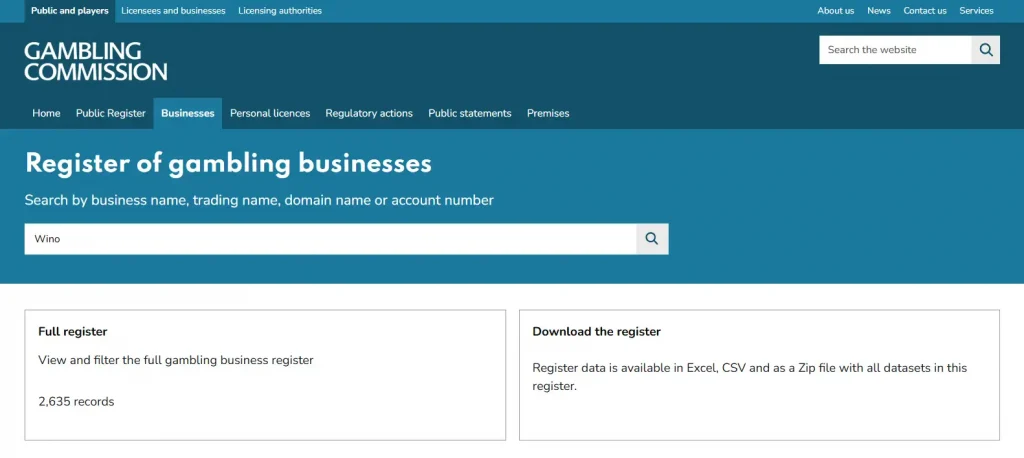
Licence and consumer-protection check
No UK Gambling Commission licence was verified for Wino in the current public-register check covering Wino, its known domains and operator aliases. That matters because the UKGC states that an operator providing remote gambling facilities to consumers in Great Britain needs the appropriate Commission licence. Separately, current independent licence-record data associates wino.casino with Softon Ltd and Anjouan Gaming licence ALSI-202409012-FI1. The same record currently labels that licence active while also showing an expiry date of 6 September 2026, so this guide does not present the licence number or current active status as an unquestioned official fact. Wino markets to UK players, but marketing access, offshore licensing and UKGC authorisation are three different questions.
Table of Contents
- The UKGC register result comes first
- What the Anjouan evidence does and does not establish
- GAMSTOP should not be assumed to apply to Wino
- UKGC protections are a package, not just a logo
- Wino's own responsible-gambling tools still matter
- Complaint evidence is a signal, not a verdict
- How to verify the licence position yourself
- What to check before depositing from Great Britain
- What Wino's licence position means for players in Great Britain
The UKGC register result comes first
The UK Gambling Commission maintains a public business register searchable by business name, trading name, domain name or account number. For this guide, the current check covered Wino, wino.casino, winocasino.co, Softon Ltd and Group Gaem B.V. No UKGC licence was verified for those Wino-related searches. The register itself was updated on 25 September 2026 when checked for this page.
This is a narrower and more useful statement than saying Wino is simply “licensed” or “unlicensed” without context. The result means this review did not verify a UKGC operating licence connected to Wino in the current register. It does not erase evidence of an offshore licence in another jurisdiction, and it does not by itself prove whether a particular visitor can technically open the site or create an account.
The regulatory requirement is also clear. The UKGC states that businesses providing remote gambling facilities to consumers in Great Britain need the appropriate operating licence, regardless of where the business itself is based. That is why a UK-facing marketing page is not a substitute for a UKGC register hit.
You can check the regulator directly in the UK Gambling Commission business register and read the Commission’s remote casino operating licence guidance.
What the Anjouan evidence does and does not establish
Independent licence-record sources associate Wino with Anjouan Gaming in the Union of Comoros. A current iGregulator record maps wino.casino to Softon Ltd and displays licence ALSI-202409012-FI1. It also says the record was read from the Anjouan source on 28 September 2026.
There is an important inconsistency in that record: it labels the licence “active” but also displays an expiry date of 6 September 2026, which is already in the past. Because licence numbers, expiry dates and current status are high-risk details, this guide treats the jurisdiction link as supported while keeping the exact number and present status qualified. The evidence is useful for understanding the offshore licensing route, but it is not equivalent to a fresh official UKGC authorisation.
| Question | Current evidence | What it means |
|---|---|---|
| UKGC licence for Wino | No licence verified in the current UKGC register check | Do not assume UKGC oversight or UKGC-linked protections apply to Wino |
| Offshore jurisdiction | Independent records associate Wino with Anjouan Gaming | There is evidence of a separate offshore licensing framework |
| Operator name | Registry-mirror and industry sources link wino.casino to Softon Ltd | Useful attribution, but not a substitute for an official UKGC business entry |
| Licence number/status | ALSI-202409012-FI1 is shown, but the record says active past its displayed expiry date | Treat number and live status cautiously until an official current register record resolves the inconsistency |
The core lesson is that “licensed” is not a single global status. A licence belongs to a jurisdiction and carries the rules and enforcement mechanisms of that jurisdiction. For a reader in Great Britain, the practical question is therefore not only whether Wino is associated with any licence, but whether the protections you expect from a UKGC-licensed remote operator are actually attached to this brand.
GAMSTOP should not be assumed to apply to Wino
The UKGC’s remote multi-operator social-responsibility code requires covered remote licensees to participate in the national multi-operator self-exclusion scheme. For online gambling in Great Britain, that scheme is GAMSTOP. This is a licensed-market requirement, not a generic feature that automatically follows every gambling website aimed at UK users.
Because no UKGC licence was verified for Wino, this guide does not state that GAMSTOP applies to Wino. Wino’s own material says account tools include deposit limits, session reminders and self-exclusion. Those are relevant responsible-gambling features, but they should not be presented as equivalent to a regulator-mandated multi-operator scheme that can cover participating licensed operators across the market.
If multi-operator self-exclusion is important to your decision, verify participation independently before depositing. A site-level self-exclusion tool can restrict one account, while a national multi-operator scheme is designed for a different scope.
UKGC protections are a package, not just a logo
A UKGC licence is tied to enforceable licence conditions and technical or social-responsibility rules. That framework is why the absence of a verified register entry matters more than whether a site uses UK wording, GBP references or British sports imagery. Several current Great Britain rules illustrate the practical difference.
- Online slot stakes: at UKGC-licensed sites, the maximum online-slot stake per game cycle is £5 for customers aged 25 and over and £2 for customers aged 18 to 24.
- Financial vulnerability checks: covered remote licensees must conduct a light-touch check when a customer’s deposits minus withdrawals exceed £150 in a rolling 30-day period, subject to the rule’s scope and previous-check provisions.
- Multi-operator self-exclusion: covered remote licensees must participate in the national scheme.
These examples do not prove what Wino itself does. They define parts of the regulatory environment that apply to covered UKGC licensees. Without a verified UKGC licence for Wino, it would be misleading to write as though these protections automatically govern the Wino account experience.
The same principle applies to complaints and dispute resolution. A reader should not assume access to a UKGC-linked dispute route, ADR arrangement or other licensed-market mechanism merely because a casino has a UK-facing webpage.
Wino’s own responsible-gambling tools still matter
Wino states that it provides deposit limits, session reminders and self-exclusion. Those tools are worth checking directly inside the account because they can help you control play at platform level. Their existence is separate from the question of which regulator supervises the operator.
A useful way to assess them is operationally: find where the limit setting sits, check whether a reduction takes effect promptly, identify how a cooling-off or exclusion request is initiated, and confirm what happens to account access after activation. Do not assume that the account process matches a UKGC-licensed operator’s process simply because the names of the tools sound familiar.
If you are also considering how identity checks interact with account control, the Wino registration and KYC guide keeps those verification questions separate from licensing.
Complaint evidence is a signal, not a verdict
Independent complaint data adds context but should be attributed rather than converted into an absolute statement that a casino is safe or unsafe. Casino Guru’s Wino review, updated in August 2026, currently lists 16 complaints in total, including 9 unresolved and 7 rejected, and says the casino does not cooperate with its complaint specialists on complaints submitted through that service.
Those figures are useful because they show that documented disputes exist, but they come from one private review platform with its own intake, classification and scoring methodology. They do not establish the outcome of every player dispute and they do not replace a regulator’s enforcement record. The right use of this information is as a due-diligence prompt: read the complaint themes, compare them with current terms, and keep your own account and payment records if you choose to play.
For payout-specific checks, including why exact limits and processing times are not repeated without primary confirmation, see the Wino withdrawals guide.
How to verify the licence position yourself
- Search the UKGC register: try the brand name, visible domain and any operator name disclosed in current terms.
- Open the business record: a genuine hit should show the account name, licence status and licensed activities rather than relying on a search-engine snippet.
- Match the domain: confirm that the gambling domain you intend to use is actually connected with the licensee record.
- Check the offshore record separately: do not treat an Anjouan or other offshore entry as if it were a UKGC licence.
- Look for date consistency: if a mirror says “active” but also shows an expired date, treat that conflict as unresolved until a current primary record clarifies it.
- Keep access and authorisation separate: being able to reach a website from Great Britain does not itself show that the operator holds UKGC authorisation.
This method also helps avoid a common comparison error: mixing product quality with regulatory status. A casino can have a large game library, bonuses and working payments while still raising a separate licensing question. The full Wino review covers those product features without using them as evidence of regulatory authorisation.
What to check before depositing from Great Britain
Start with the exact domain and operator details shown in the current terms. Then search those identifiers in the UKGC register yourself. If no current UKGC entry appears, do not assume that UKGC rules, GAMSTOP participation or licensed-market dispute protections apply to the account. Review Wino’s own responsible-gambling controls separately, and read the cashier and withdrawal rules before moving funds.
Bonuses deserve the same separation. A large welcome offer can be a commercial feature without answering a licensing question. If you are evaluating an offer, use the Wino Casino bonus guide for the current package and the conflicts found across Wino’s own pages. For deposits and account currencies, use the payment options guide rather than treating regulatory status as a proxy for cashier details.
What Wino’s licence position means for players in Great Britain
The current evidence supports a precise conclusion rather than a binary trust label. Wino actively markets casino content to UK players and is associated by independent licence records with Anjouan Gaming and Softon Ltd. At the same time, no UK Gambling Commission licence was verified for Wino in the current public-register search, and the offshore record shows a status/date inconsistency that prevents this guide from treating the displayed licence number and active status as fully settled. For players in Great Britain, the practical consequence is that UKGC-specific protections should not be assumed to apply to Wino. Evaluate the site-level tools and product features on their own merits, verify the register position before depositing, and distinguish technical access from regulatory authorisation.